2075
Operating Systems
Full Marks: 60
Pass Marks: 24
Time: 3 hours
Candidates are required to give their answers in their own words as far as practicable. The figures in the margin indicate full marks.
Section A (2×10=20)
Attempt any two questions:
Explain operating system as a resource manager and extended machine. Distinguish between Batch systems and Time sharing systems.
OR
What is Real Time Operating system? List the types. “Operating system is broker between computer System and User”. Justify the statement.
What is difference between Deadlock and Starvation? Consider the following four resources A, B, C and D with five processes and answer the questions.
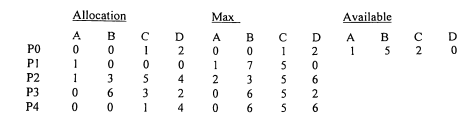
a) Is the system in a safe state? Use Banker algorithm. If yes give the sequence.
b) If a request from process from P1 arrives for (0, 4, 2, 0), can this request be granted immediately?
Five batch jobs A through E, arrive at a computer center at almost same time. They have estimated running times of 10, 6, 2, and 6. Their priorities are 3, 5, 2, 1 and 4 respectively, with 5 being the highest priority. For each of the following scheduling algorithms, determine the mean process turnaround time. Ignore process switching time and context switching overhead.
a) Round Robin (Quantum =2)
b) Priority Scheduling
c) SJF
Section B (8×5=40)
Attempt any eight questions:
- What is critical section problem? Why executing critical selection must be mutual exclusive? Explain.
- Suppose that a disk drive has the cylinder numbered 0 to 199 is currently serving a request at cylinder 143. The queue it request is kept in the FIFO order 25, 17, 119, 197, 194, 15, 182, 115, 183. What is the total head movement needed to satisfy these request for the following disk scheduling algorithm.
- a) FCFS
- b) SSTF
- What is Critical Section Problem? Describe the criteria to be satisfied for solving this problem.
- How Producer-Consumer problem can be solved with sleep and wakeup primitives? Explain.
- Describe the methods for implementing files.
- Why do deadlock occurs? How can you detect and recover from deadlock?
- What is swapping? Differentiate contiguous memory allocation with non contiguous memory allocation.
- Discuss the working principles and advantages of Direct Memory Access.
- What is the purpose of system call in OS? Differentiate between thread and process.